
Most warehouse managers know their racking has to be inspected. Far fewer are confident about the two questions that actually decide whether an inspection regime holds up: who was competent to carry the inspection out, and whether it happened often enough. Those are the questions asked after a collapse, and a regime built on a quick walk round by whoever was free that morning does not survive them.
Pallet racking is work equipment. Under the Provision and Use of Work Equipment Regulations 1998, the operator has a duty to keep work equipment in efficient working order and in good repair. BS EN 15635, the standard covering the application and maintenance of static steel storage systems, sets out how that duty is discharged for racking in particular. Neither obligation transfers to the firm that supplied or installed the system.
The duty sits with the operator: why this is not the supplier’s problem
This is the single most common misunderstanding Rackline encounters on site. A warehouse buys racking, the installer hands over a system that is plumb, level and correctly load-marked, and the assumption settles in that safety has been dealt with at the point of purchase. It has not. From the moment the first pallet goes in, the condition of the installation is governed by how it is used — forklift strikes, overloading, beams relocated without checking the implications, uprights damaged at floor level and never reported.
BS EN 15635 asks the operator to appoint a named individual responsible for storage equipment safety, usually abbreviated to PRSES. That person does not need to be a structural engineer. They need the authority to stop racking being used, the training to recognise damage, and a route by which damage reported by the people on the floor reaches them quickly. Appointing somebody without those three things is a paper exercise.
Three tiers of inspection: who carries out which
The standard describes a layered system rather than a single annual event, and the layers do different jobs.
Immediate reporting is everyone’s responsibility. Anyone who strikes a rack, or sees one struck, reports it the same day. This tier catches the damage that matters most, because it is the damage nobody else will see until the next formal inspection.
Regular visual inspection is carried out by the PRSES. BS EN 15635 frames this as weekly or at another regular interval set by risk assessment, which is a deliberate allowance for the fact that a cold store handled by two pickers and a high-throughput distribution centre running three shifts do not carry the same risk. The output is a written record, not a mental note.
Expert inspection is carried out by a technically competent person who is independent of the day-to-day operation. The standard sets a maximum interval of twelve months between expert inspections. This is the tier that produces a formal report, classifies the damage found, and tells you what has to be done about it.
Competence, not job title: what actually qualifies an inspector
The standard asks for a technically competent person and declines to define that as a specific qualification, which is where sites get into trouble. In practice, competence means the inspector can do four things: identify the system and its configuration, recognise damage against the classification criteria, understand the structural consequence of what they are looking at, and set out the remedial action with a timescale.
SEMA’s approved rack inspector scheme is the most widely recognised route to demonstrating that in the UK, and using a SEMA-approved inspector is the straightforward way to show the expert tier has been properly resourced. It is not the only route — a manufacturer’s own trained engineers inspecting their own systems is a defensible arrangement — but if you cannot articulate why the person who signed your last report was competent, that is the gap to close first. Ask any prospective inspector what they are accredited to inspect, and check that it covers the system types you actually have. An inspector familiar with adjustable pallet racking is not automatically competent on push-back or other dynamic systems.
Frequency: what the standard sets, and what your site actually needs
Twelve months is a maximum, not a target. It is the right interval for a stable, lightly trafficked installation that has not changed. Several things should pull the expert inspection forward:
A change of use — different pallet types, heavier unit loads, a shift from full-pallet to case picking — alters the loading pattern the system was designed around. A change of layout does the same, and beam levels moved without recalculating the configuration are one of the most common faults found on inspection. A spike in reported strikes points to an aisle width, floor marking or traffic routing problem that will keep producing damage. And racking that has been dismantled and re-erected, whether on the same site or a new one, needs inspecting after the move regardless of when the last one was: the checks for that are set out in more detail in what to check before relocating racking.
The reverse case is worth stating too. A twelve-month interval on a site that has just doubled throughput is compliant with the letter of the standard and plainly inadequate. The risk assessment, not the calendar, should be setting the interval.
Damage classification: what green, amber and red oblige you to do
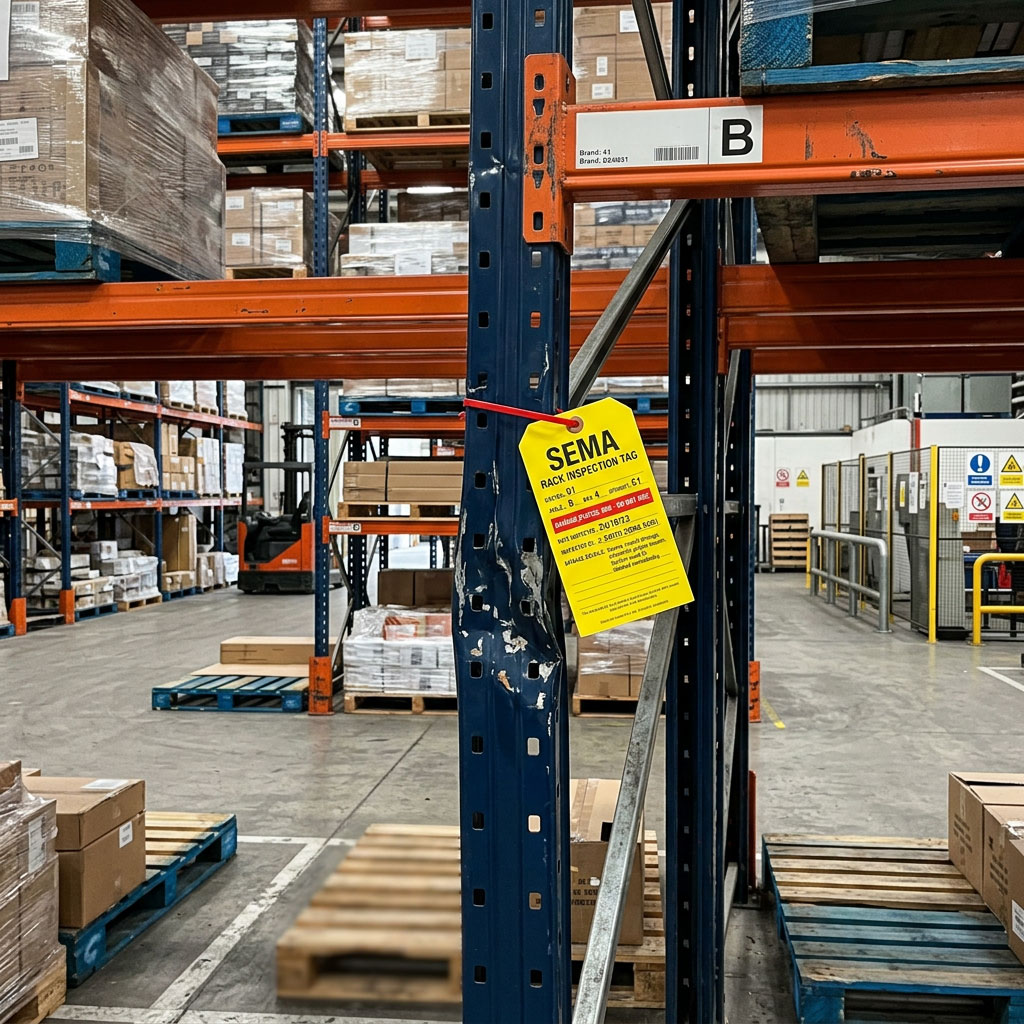
An expert inspection report classifies what it finds rather than simply listing it, and the classification carries an obligation. The widely used SEMA scheme runs on three colours.
Green means damage within acceptable limits. The component stays in service and is noted for monitoring at the next inspection. Green is not the same as undamaged, and a report full of green entries that grows every year is telling you something about how the site is operated.
Amber means damage serious enough that the component must be offloaded and repaired or replaced within a defined period set out in the classification. The beam or upright can stay loaded until it is emptied in the normal course of operation, but it must not be reloaded afterwards. In practice this is the tier that gets mishandled: the pallet is picked, the location looks empty and available, and it is refilled by someone who never saw the report.
Red means immediate action. The affected bay is offloaded and isolated straight away, and stays out of use until the component is repaired or replaced. Red entries should trigger a physical barrier and a location block in the warehouse management system on the day, not a work order in a queue.
The precise measurement thresholds that separate the three sit in the classification criteria and in the manufacturer’s data for your particular system, and they vary by component and system type. Take them from the inspector’s report and the standard rather than from a rule of thumb. The colour coding system is covered in more detail here.
Load notices and records: the paperwork an inspector will ask for
An expert inspection is not only a visual survey. The inspector needs to know what the system was designed to carry in order to judge whether it is being used as intended, which means the load notices need to be present, legible and correct for the current configuration. A load notice that refers to a beam level arrangement that was changed two years ago is worse than no notice at all, because it authorises a loading pattern the racking is no longer set up for. What a load notice has to show is a short subject in itself and worth getting right before the inspector arrives.
Alongside the notices, expect to be asked for the previous expert inspection report and what was done about it, the log of regular visual inspections, and the damage reports raised since. The value of the file is not that it exists but that it shows a loop closing: damage reported, classified, acted on, verified. An inspection history with findings and no corresponding repairs is the clearest evidence of a regime that is being documented rather than operated.
After the report: repair, replace or de-rate
A finding is not automatically a replacement. Depending on the component and the severity, the options are proprietary repair, replacement of the damaged member, or reconfiguring and re-rating the bay so it is used within what it can now safely carry. What is not an option is a local fix — welding, straightening or plating a damaged upright on site — unless it is carried out to the manufacturer’s approved method. A straightened upright looks repaired and no longer performs as the design assumed, which is precisely the failure mode that gives no warning.
Where damage is widespread rather than isolated, the honest answer is often that the installation has reached the end of its serviceable life in its current duty, and the conversation moves from repair to replacement or redesign. Rackline has designed, manufactured and installed storage systems since 1984, and that assessment — repair, re-rate or replace — is the one it is most often asked to make on existing pallet racking installations. If the system is being reconfigured anyway, it is worth doing the layout work properly rather than patching: phasing a racking retrofit in an occupied building covers how that is sequenced without stopping operations.
So how do you know your inspection regime is good enough?
Four questions will tell you quickly. Can you name the person responsible for storage equipment safety, and do they have the authority to stop racking being used? Can you produce the last expert inspection report, and say why the person who signed it was competent to? Does every amber and red finding in that report have a dated action against it? And does a forklift strike today reach that named person today?
If any of those four is uncertain, the gap is in the regime rather than in the racking, and it is a cheaper problem to fix now than to explain later. Rackline carries out inspections and remedial work through its racking maintenance service, and will say plainly when an installation is better replaced than repaired.
Not sure your racking inspection regime stands up?
Send the racking type, the approximate age of the installation and the date of the last expert inspection, and Rackline will tell you what the regime should look like.