
Most offices that outgrow their filing do not need more storage. They need the same storage to occupy less floor. The usual answers are a denser cabinet, a mobile system on tracks, or a rotary unit — and of the three, rotary is the one specifiers understand least well. It is often dismissed as a novelty, or specified into a room that cannot take it.
Rackline has designed, manufactured and installed storage systems since 1984, and the rotary question tends to arrive from offices that have already tried the obvious fix. This is how to judge whether a rotary unit earns its place.
What a rotary unit actually is: two faces on one turning frame
A rotary cabinet holds files on both sides of a frame that turns about a vertical spindle. The user rotates the frame to bring the required face forward, then works at it much as they would at open shelving. Some units carry several tiers, each turning independently, so two people can work at different levels of the same cabinet at the same time.
The difference from a conventional cabinet is where the capacity comes from. A vertical or lateral filing cabinet stores files in one plane and needs drawer-pull space in front of it. A rotary unit stores files in two planes and needs only standing room, because the back face is reached by turning the frame rather than by walking round it. That is the whole proposition, and it is why rotary sits between static shelving and a mobile shelving system in density terms.
Access pattern: the question that decides it before capacity does
Capacity is the wrong first question. The first question is how the files are used.
Rotary suits files that are consulted often, by a small number of people, in short visits: live case files, personnel records, patient notes, drawings in current use. One person turns the frame, takes what they need and leaves. Throughput is high because there is no gangway to open and no drawer to clear.
It suits shared, simultaneous access badly. A frame can present only one face at a time, so two people wanting opposite faces of the same tier have to take turns. In a records office where six people file continuously through the day, that queue is real and users notice it within a week. Count the people who need the same unit at the same moment in the busiest hour, not the average across the day.
Where the files are dormant — closed cases, retained records, anything consulted a few times a year — rotary is the wrong tool. That volume belongs in archive storage, where density matters and retrieval speed does not.
Floor area against file metres: how to work out whether it pays
The comparison that matters is linear file metres held per square metre of floor occupied, and it has to include the space the system needs in order to work, not only the space it stands on.
Work it out like this. Measure the linear metres of filing actually held — shelf run, not drawer count — and add a realistic allowance for growth across the life of the system. Then, for each option, take the unit’s own footprint and add its operating space: drawer extension for a cabinet, a gangway for static shelving, a single gangway shared across the whole bank for mobile shelving, and turning clearance plus one standing position for rotary. Divide file metres by total area. Compare.
The answer is rarely obvious in advance, because rotary’s advantage depends on how many units are needed. One rotary unit against one cabinet is usually a clear win. A bank of eight rotary units against a mobile shelving run of the same capacity usually is not, because at that scale one gangway serving an entire bank beats a standing position in front of every unit. Rotary’s sweet spot is the middle: more than a few cabinets’ worth, less than a room full. Rackline’s guide to static, rotary or mobile storage sets the three side by side.
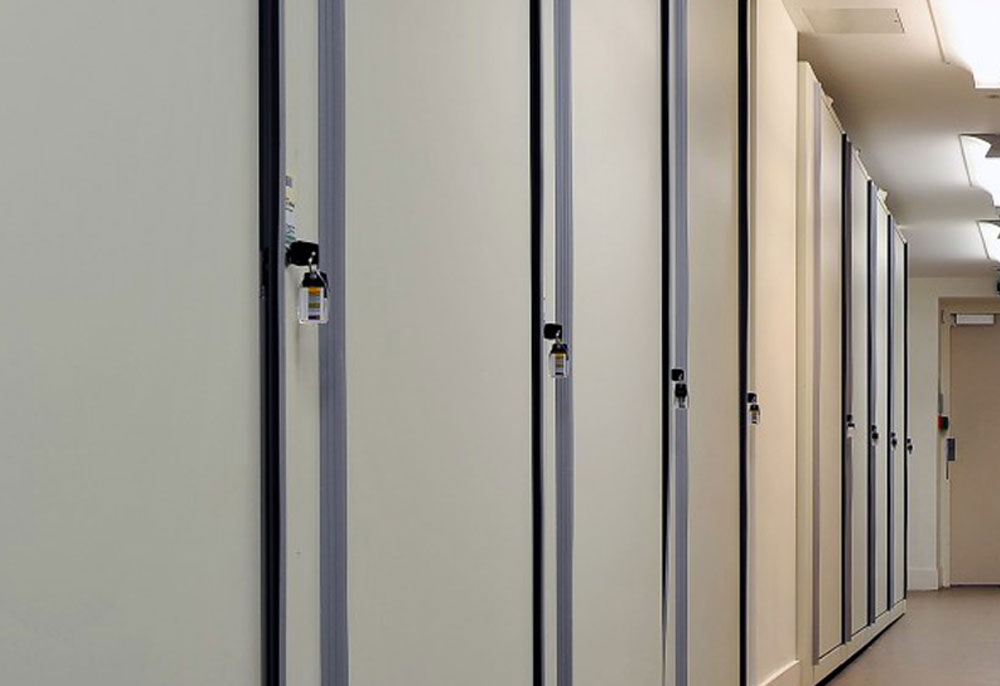
Room shape and clearance: where rotary quietly fails
A rotary unit needs clear space in front of it and nothing obstructing the turn. That sounds trivial until a unit is specified for a room that does not suit it.
Three things catch people out. Narrow rooms: a rotary unit in a corridor-shaped office leaves no standing position that is not also the walkway. Columns and radiators: an alcove that comfortably takes a cabinet may not take a unit the user has to stand square to. Door swings: a unit sited behind an inward-opening door loses its standing position every time someone comes in.
Measure the room, not the wall. Mark the standing position on the plan and check that it does not overlap a circulation route, the travel of a desk chair, or an escape route. If it does, the unit will be worked from an awkward angle, which is how rotary units acquire a reputation for being hard to use.
Floor loading: the check that is easiest to skip and worst to get wrong
Dense filing is heavy, and a rotary unit concentrates that weight onto a small footprint. Paper is among the heaviest loads an office floor is asked to carry, and it is the concentration rather than the total that governs.
The method is straightforward. Establish the imposed floor loading the building was designed for — for UK buildings this follows from the structural design to BS EN 1991-1-1, and for an office it is usually recorded in the building documentation or obtainable from the landlord or a structural engineer. Then compare it against the loaded weight of the proposed system divided by the area it bears on. Do this before ordering rather than after. On an upper floor, in a converted building, or anywhere the original use was lighter than filing, this is the check that changes the specification.
Do not assume that a floor carrying static shelving will carry the same filing in rotary form. The total can be identical while the load per square metre is not.
Security and confidentiality: where rotary earns its place
Rotary has one advantage that has nothing to do with density. Because the frame turns within an enclosure, files are out of sight when the unit is not in use: only the presented face is visible, and on many units nothing is visible once it is closed. For personnel files, patient records, legal case files and anything governed by a retention or confidentiality policy, that is a meaningful difference from open shelving standing in the same room.
Where the requirement is formal rather than practical — controlled access, auditable locking, resistance to forced entry — the comparison is with purpose-built secure storage cabinets rather than with other filing. The two are often specified together: rotary for the live files, a secure cabinet for the subset that needs more than discretion.
What rotary is not: three jobs it should not be given
First, it is not a bulk archive solution. Density per unit is good; density per room, at volume, is better served by mobile shelving.
Second, it is not a fix for a filing system with no structure. A frame that turns does not make a badly classified file easier to find. Where retrieval is slow because nobody can tell where a file ought to sit, the problem is the classification, and the way the filing system itself is organised is the place to start.
Third, it is not format-agnostic. Rotary suits suspended and lateral filing, box files and ring binders. Large-format drawings, rolled plans, framed items and anything that will not sit square on a shelf need a different answer altogether.
So is a rotary filing cabinet right for your office?
It is, if the files are live and consulted often, if one or two people use each unit rather than six, if the volume sits above a handful of cabinets and below a room full, if the room offers a clean standing position, and if the floor takes the load. Miss any of those and another system will serve better — which is not a failure of rotary, only of the match.
The honest way to settle it is to work the numbers for two or three options rather than one. Rackline designs, manufactures and installs rotary storage units alongside static shelving, mobile systems and secure cabinets from its Staffordshire factory, and will set the options against each other on the real room rather than on a generic layout.
Weighing up rotary against another filing system?
Send the room dimensions, the linear file metres held and how many people need access at once, and Rackline will say whether rotary is the right fit.